
Bespoke Central Production Units: How Encore Built a CPU Around Nova Chef in Colindale
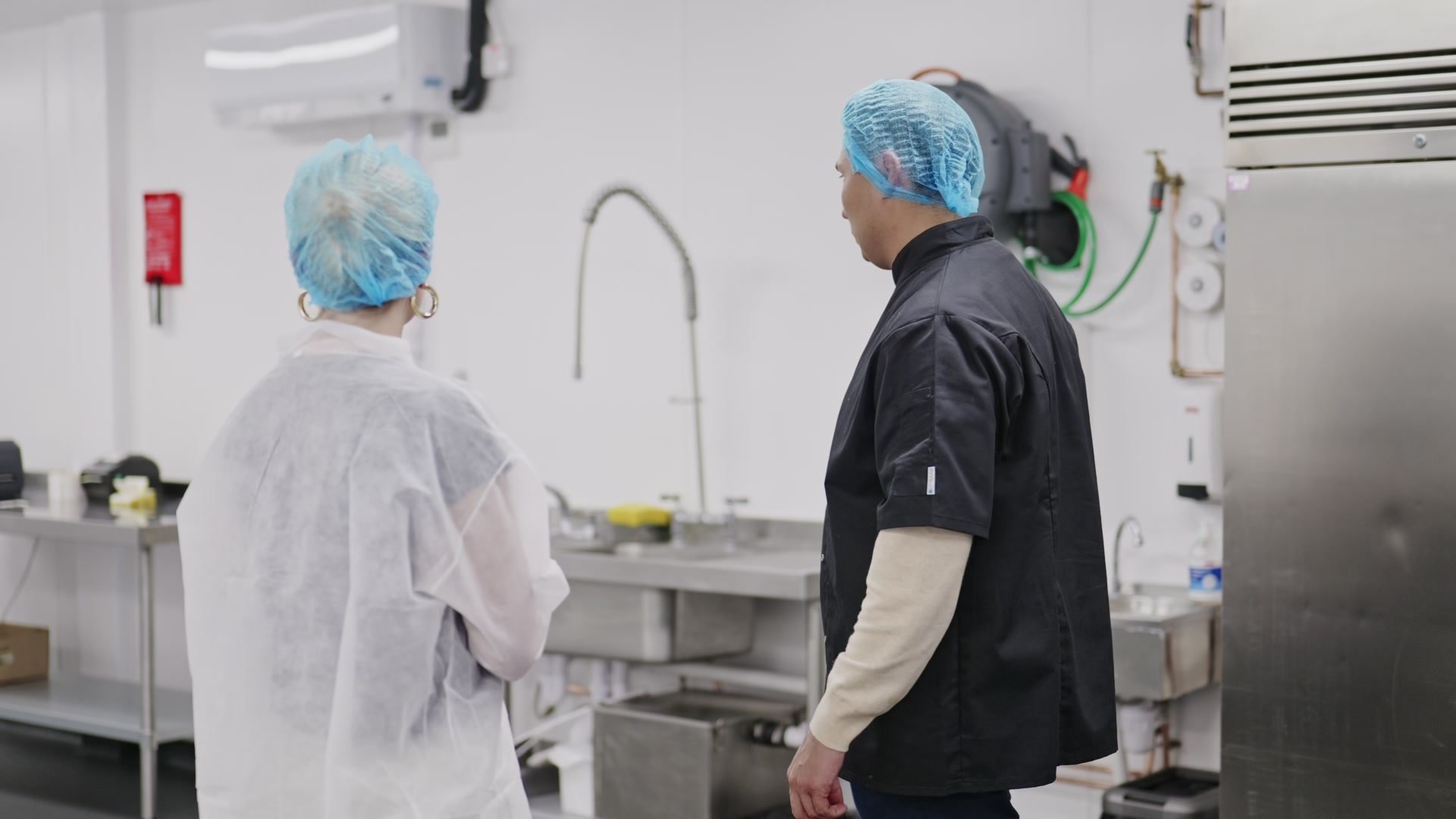
Encore Kitchens builds Central Production Units around businesses needing to expand, and its Colindale site shows how far that can go. There, 16 of the building's kitchens have been opened up into a single production facility for Nova Chef, a London food manufacturer supplying more than 60 hotels, workplaces and institutions across the UK.
A bespoke CPU like this one is designed around one operator's workflow, output and food safety requirements, rather than a fixed set of rooms. For Nova Chef, the challenge was bringing production from several sites together without compromising the food safety standards and quality its customers expect. Encore worked with the team to plan the space, bring in the right specialists and structure the terms around the build, creating a facility built to BRCGS standards to future-proof Nova Chef's operations. This is how the project came together.
About Nova Chef
Nova Chef was founded in 2022 by chef and restaurateur Sergey Men and Danat Abdrakhmanov. The concept began at Sergey's Michelin Guide-recognised restaurant, Bisushima, as a way to serve dishes cooked properly by chefs, flash-frozen at their best and finished on site in minutes.
Today, that food is served in 4 and 5-star hotels, workplace canteens, sports clubs and universities, without the need for a chef brigade. Nova Chef also produces food for other businesses under their own labels, from independent restaurants and caterers to restaurant groups and established food brands. All of it is made centrally and sent out to be served under someone else's roof. So food safety sits at the heart of how the business runs, and of what it needs from a production space.
“As a food manufacturer, we have to comply with British food safety regulations, but we go beyond that. As a supplier to some of the biggest brands in hospitality, we have to protect not only our own reputation, but theirs as well.”
The search for a single production site
Nova Chef's production had been spread across several sites, and the business wanted to consolidate their operations under one roof. Finding somewhere suitable was not straightforward.
“When we were looking for a new base to expand our production, it was quite a challenge to find a location that suited our operation and had the right amount of space. Most importantly, it needed to support the highest standards of compliance and food safety.”
For Nova Chef, those standards meant BRCGS, a GFSI-recognised food safety certification that many UK retailers prefer their direct suppliers to hold, and one that now operates under the signature “Brand Reputation through Compliance”. Certification is awarded to the food business after an independent audit, but the building plays a large part, because the standard looks closely at how product moves through a site and how different areas are kept apart. The layout had to be right from the start.
As Encore's team learned more about the operation, the brief grew, and the decision to settle on their Colindale facility was made.
How Encore planned and delivered the facility
From there, Encore's role was to turn Nova Chef's requirements into a working facility, coordinating the planning, the specialists and the build from the first conversation onwards.
The building gave the team a strong starting point. Every Encore kitchen comes with extraction, three-phase power and gas already installed, and the sites are designed so kitchens can be combined. When several kitchens are joined together, their capacity is joined too. At Colindale, the goal was one continuous production flow, with clearly defined zones along the way:
- An auditor before any building work. Encore arranged for a BRCGS auditor to walk the floor with the Encore and Nova Chef teams. The auditor set out how the space needed to be arranged, including where safety and cleaning zones should sit, and that guidance became the blueprint for the build.
- A managed build. Encore's operations and build team introduced Nova Chef to the contractors who carried out the works, and guided the project through to completion. Most of the walls between the 16 kitchens came down, and the floor was rebuilt as one production facility.
- Terms that fitted the project. Encore structured the agreement so Nova Chef could complete the works before its regular licence fee began, keeping upfront costs manageable while the facility took shape.
- Support after move-in. Encore's account management team remains Nova Chef's point of contact for anything the site needs.
For Danat, Encore's willingness to adapt the building to Nova Chef's specification and workflow is what set it apart.
Read the video transcript
"Our production base is paramount for us as a food manufacturer, as somebody who's producing physical goods, because that gives us capacity to produce and to grow.
When we were looking for a new base to expand our production, it was quite a challenge to find a location that suits our operation, but also the size of the space, but most importantly a location that can support the highest compliance standards and food safety.
We looked at a number of spaces within Encore's estate, and the company has been really helpful in understanding what the requirements are, and was willing and able to adjust the space for us, to build it out according to our spec, to our workflow and to our safety and regulatory needs. Obviously not a lot of companies are able to provide that, and the support has been fantastic. We are very grateful and very happy to partner with Encore because of that."
Building on infrastructure already in place
One advantage for Nova Chef was that it wasn't starting with an empty industrial unit. The infrastructure every production kitchen depends on was already installed at Colindale, as it is across Encore's sites, so its investment could focus on adapting the space for production rather than building a facility from the ground up.
| Infrastructure | At Encore | Building from scratch |
|---|---|---|
| Power supply (substation / three-phase power at the right capacity) | Already in place | Can run to around £750,000 subject to DNO availability |
| Extraction canopies and HVAC ducting | Already in place | Hundreds of thousands of pounds |
| Plumbing, drainage and sinks | Already in place | A significant cost, varying by site |
| Business rates | Included in the licence fee | Paid on top of rent |
Fitting out an empty warehouse to a similar standard can cost upwards of £1 million before production begins. As with all Encore CPU tenants, Nova Chef then brought in its own cooking equipment and connected it directly to the pre-installed power, gas and ventilation, with no major retrofit required.
Nova Chef today
Nova Chef now has a production base built to BRCGS standards, alongside the SALSA approval it already holds. For Danat, the difference shows up in the day-to-day running of the business:
“We used to operate across several sites. Now it's one big site, which gives us a lot of efficiency gains. Maximising efficiency and reducing labour costs is critical these days, and this new space really enables us to operate as efficiently as possible.”
It also gives Nova Chef the capacity to keep growing, including through its second-generation Scan-to-Cook Station, a countertop unit that lets any member of staff finish Nova Chef dishes by scanning the pack.
Watch: what it takes to build a production facility around a growing business
Read the video transcript
Alice, Encore Kitchens: "What does it take to build a food production facility around a growing business? Today we're at Encore Kitchens in Colindale, showing you a bespoke central production unit we've developed for Nova Chef. This isn't a one-size-fits-all kitchen. The layout and infrastructure have been planned around Nova Chef's production needs, helping the team work efficiently and prepare for the next stage of growth. A key part of the brief was designing the space fit for compliance with food safety standards. Why was that important for Nova Chef?"
Danat Abdrakhmanov, Nova Chef: "As a food manufacturer, we obviously have to comply with British food safety regulations, but we really do go beyond that, because as a supplier to some of the biggest brands in the hospitality world, we have to take care not only of our reputation but also protect their reputation as well."
Alice: "And beyond the space itself, what does a dedicated production base make possible for your business?"
Danat: "Our production base, as a food manufacturer, as somebody who's producing physical goods, is paramount, because that gives us capacity to produce and to grow. We need to have the base, the roots, the foundation to produce the products for our customers. It's a really exciting time for us. Now we're going into a hardware world, where we are able to give other businesses, such as hotels and hospitality venues, a chefless restaurant solution. This was reintroduced just three weeks ago, and we already have quite a healthy number of customers that we've installed it with. That is the future for Nova Chef: restaurant-quality meals, but without chefs. We looked at a number of spaces within Encore's estate, and the company has been really helpful in understanding what the requirements are, and was willing and able to adjust the space for us, to build it out according to our spec, to our workflow and to our safety and regulatory needs. We are very grateful and very happy to partner with Encore because of that."
Alice: "This is what we mean by building around a business, not just providing a kitchen. At Encore, we create the space and infrastructure to help food brands scale. So if you're planning your next move, let's talk."
How Encore builds CPUs around each business
The approach behind Nova Chef's facility is the one Encore brings to every Central Production Unit. Each enquiry is treated as a brief: the team starts with what an operator needs to produce, in what volume and to what standard, then plans how its network of production sites can deliver it. With the core infrastructure already in place and its own operations and build team to manage the works, Encore can redesign a layout to suit the business moving in.
Depending on the site, Encore can:
- Merge kitchens, from two up to a whole floor
- Create a single cookline, rearranging kitchens on site where needed so production runs in one continuous line
- Zone the space around a certification, a product type or a production flow
- Bring in specialists, from contractors and auditors to the catering equipment suppliers Encore works with
- Grow with the business, with more space on the same site or a second CPU elsewhere in the network
Who moves into a CPU
Encore's CPU tenants are most often caterers, along with food manufacturers, ready-meal and meal-prep brands, bakeries and restaurant groups centralising prep for several brands. The move usually follows one of a few moments:
- The current kitchen is at capacity, whether that's the space, the equipment or the team that fits in it.
- Production is spread across several sites, adding labour, transport and management time, as it was for Nova Chef.
- A new contract changes the geography. Winning a large client outside the usual delivery area can mean needing a bigger site, well placed to serve both.
- Customers require certification. Supplying hotel groups, retailers or large corporates often means working to standards such as BRCGS or SALSA, which begins with the right layout.
Build your production space with Encore
Encore Kitchens provides Central Production Units and production space across London, Birmingham, Manchester and Leeds, from around 500 sq ft to 10,000 sq ft.
Nova Chef came to Encore needing to bring production together under one roof, in a space built to a demanding food safety standard. Other businesses arrive with different starting points: a kitchen at capacity, a new contract, or a certification their customers now require. Every project starts with a conversation about your operation, and Encore's team plans a space around it, from a single kitchen to an entire floor, staying involved through the build and beyond.
Ready to plan your production space?
Book a viewing with Encore and start planning a production space built around your business.
FAQs
What is a bespoke Central Production Unit?
A bespoke Central Production Unit (CPU) is a production kitchen planned around how one business actually works: what it produces, in what volume, how its team moves through the space and the food safety standards its customers expect. Instead of fitting the operation into a fixed set of rooms, the space is adapted to the operation. That can mean merging kitchens into one production floor, creating a single continuous cookline, zoning areas for different stages or product types, and laying the site out to support a certification such as BRCGS or SALSA. It can also extend beyond the building itself, to commercial terms structured around a fit-out and room to take on more space as output grows. At Encore, every CPU enquiry is treated as a brief of this kind, from a few merged kitchens to an entire floor.
How do food businesses scale production without building their own facility?
Most choose between three routes. They can outsource to a contract manufacturer, which keeps capital costs low but hands day-to-day control of production to someone else. They can rent space in a shared kitchen, which suits smaller volumes but rarely supports a full production operation. Or they can move into a CPU inside an existing kitchen building, where power, gas and extraction are already installed, and pay only to adapt the space to their workflow. The third route usually involves defining output and standards, finding a site with enough capacity, agreeing the layout and any building works, and signing a licence agreement rather than a long commercial lease. Rent-free periods during fit-out are common across the industry. Encore manages much of this process for its CPU tenants, introducing contractors and specialists, overseeing the works and structuring terms around the build.
Where can I rent a CPU or production kitchen in London?
London's options range from shared commissary kitchens and empty industrial units to dedicated CPU operators. When comparing them, it's worth checking the power and gas capacity, the extraction, cold storage and loading access, whether the layout can be changed, and how flexible the contract is. Encore Kitchens operates CPU and production space across London, as well as in Birmingham, Manchester and Leeds, with spaces from around 500 sq ft to 10,000 sq ft that can be configured around each business. Explore Encore's Central Production Units to see current options.
How do I choose a CPU provider?
Start with the infrastructure: a provider should be able to show the power, gas and extraction capacity available, because these are the most expensive elements to add later. Then look at flexibility. Can kitchens be combined, can the layout be changed, and can you take more space on the same site as you grow? Support matters too, particularly if your project involves building works or a food safety certification. And the contract should suit your plans, with terms that reflect any fit-out period. Encore covers each of these, with infrastructure already installed across its sites, an operations and build team to manage works, and licence agreements with business rates included.
Who uses Central Production Units?
CPUs are used by any food business that has outgrown a single kitchen. Caterers are the most common users, alongside food manufacturers, ready-meal and meal-prep brands, bakeries supplying wholesale or online customers, and restaurant groups producing sauces, components and prep centrally for several sites or brands. The move usually follows a clear trigger: a kitchen at capacity, production spread across too many locations, a large new contract, or customers who now require a recognised food safety certification.
How much does a CPU cost in London?
CPU costs depend on the size of the space, the specification, the location and the length of the agreement. The bigger financial question is often what doesn't need paying for. Building a production facility inside an empty industrial unit means installing power, gas, extraction, ducting and drainage first, which can cost upwards of £1 million for a large facility. Renting a CPU in an existing kitchen building avoids most of that outlay. At Encore, larger footprints usually bring the cost per kitchen down, longer agreements leave more room to shape the terms, and business rates are included, with utilities and waste billed separately. Book a viewing to get figures for your requirements.
What does BRCGS stand for?
The initials come from the British Retail Consortium, which first published its Global Standard for Food in 1998. The standards have since been rebranded as BRCGS, and in 2019 adopted the signature “Brand Reputation through Compliance”. Today, the BRCGS Global Standard for Food Safety is a GFSI-recognised certification used by food manufacturers worldwide, and many UK retailers prefer their direct suppliers to hold it.
Can a rented production kitchen be set up for BRCGS?
Yes. BRCGS certification is held by the food business, not the building, and covers its whole food safety system, from procedures and training to traceability. The site still matters, because the standard includes requirements on layout, product flow and the separation of different areas. A business renting a production kitchen typically compares its current site and processes against the standard, adapts the space and procedures, then books an audit with a BRCGS-approved certification body. Encore works with CPU tenants building towards standards such as BRCGS and SALSA. For Nova Chef, it arranged for a BRCGS auditor to walk the floor before any building work began, so the layout was planned around the standard from the outset.